
Wallet and billing
You pay for each message the network accepts. If the network later reports it could not deliver a message, that message is refunded automatically. Most accounts pay from a prepaid wallet; some are set to postpaid and invoiced in arrears. The panel shows whichever applies to you.
Owner only
Wallet, recharge, billing profile and invoices are visible to the account owner alone. Operators and viewers do not see these menu entries at all.
Prepaid or postpaid
You cannot switch modes yourself. If postpaid suits your volume, talk to your account contact.
What a message costs
You are charged for each message the network accepts, at the per-message price set for the bot that sent it. Your prices are on Settings → Pricing, and different bots on one account can be priced differently.
If the network later reports that it could not deliver an accepted message (the number cannot get RCS, the message expired, or it was blocked or rejected), that message is refunded automatically, once. The refund is a line in your transaction history, usually within a few minutes of the failure report.
You send a message
        |
        v
Network accepts it? ---- no ----> not charged
        |
       yes
        v
   Charged now
        |
   Report arrives later
        |
   +----+---------------------+
   |                          |
Delivered or read        Failed or expired
(stays charged)          (refunded once, a line in your history)
Broadcasts: when the broadcast starts, the numbers it sends to are held. That is the count for its Send to choice, or all numbers on the list that have not opted out while a check on the list is still running. Each accepted message takes its share of the hold, a message that fails later is refunded, and what was not used returns when the broadcast ends. Postpaid: a message that fails later comes off its cycle, and if that cycle was already invoiced, it comes off your next invoice as Failed after billing.
Not charged:
- Numbers dropped by the opt-out filter
- Messages the network refused when they were sent
- Messages that failed after the network accepted them, including numbers that turn out not to be on RCS: charged when accepted, refunded when the failure is reported
- Numbers a bot found not on RCS in the last 30 days, which its broadcasts skip before sending with Can get RCS. See Numbers not on RCS are skipped for 30 days
- Templates rejected before sending
- Anything sent while a bot is still Processing, which covers test sends from either composer and any auto-reply that fires while you are trying a keyword out. Setting a bot up should not cost anything, and a zero balance does not stand in the way of proving it works. Charging starts when the bot goes Active.
So a broadcast costs what the network accepted less what failed after that, which is never more than its target count.
The wallet
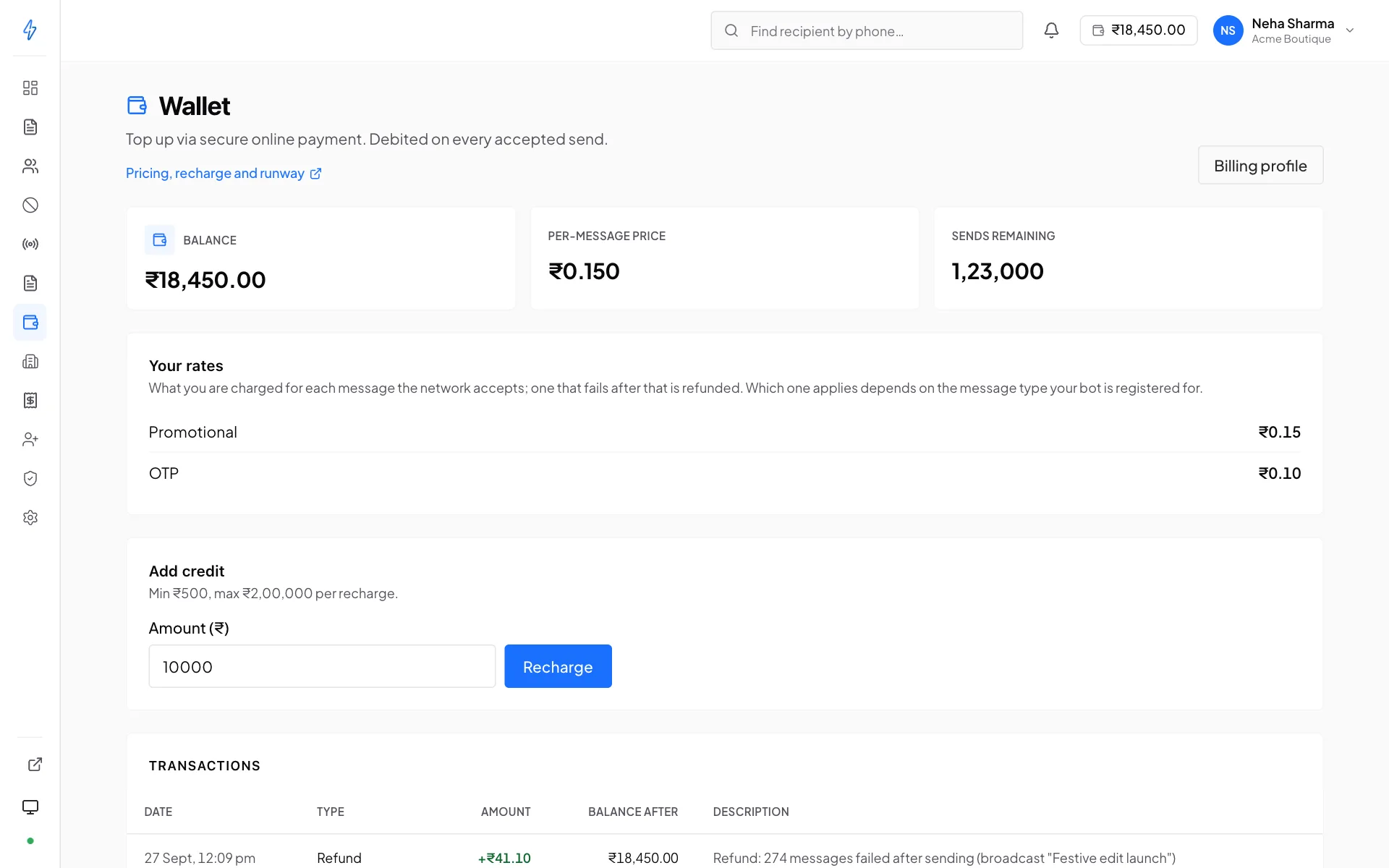
The Wallet page shows your balance, an estimate of sends remaining, and a transaction history, every recharge, hold, refund and debit, with what it was for.
Recharging
Set up your billing profile first
Recharge is blocked until the legal entity invoices are raised to is on file. This is a one-off. Billing profile →
Choose an amount
On the Wallet page, enter the amount to add.
Pay
You are taken to the payment page and returned to the panel afterwards.
Confirm the balance moved
The wallet updates once payment is confirmed, and the recharge appears in the transaction history.
If money left your account but the balance did not move
Do not recharge again. Wait a few minutes and refresh, confirmation is occasionally delayed. If it still has not landed, email [email protected] with the payment reference and the amount, and it will be reconciled. Paying twice creates a refund you then have to chase.
Sends remaining
The estimate divides your balance by the per-message price of your default bot. If your bots are priced differently, the true figure depends on which bot you send from, treat it as a guide.
Runway and low-balance alerts
The dashboard shows a runway: roughly how long the balance lasts at your recent burn rate.
Prepaid accounts also get email nudges as the runway crosses roughly seven days, three days and twenty-four hours. They exist so a campaign does not stop halfway through, which is worse than not starting.
Top up before a big send, not during
A broadcast that exhausts the wallet mid-run stops where it stops. Some of your list got the message and some did not, which is messier to recover from than a delayed campaign. Check the balance against the list size first.
Capping a day's spend
The account owner can set a daily spend limit on Settings → Pricing, for example ₹5,000 a day. At 80% of it you get a notice and an email. At 100%, new broadcasts are refused until midnight, India time, and scheduled broadcasts due that day do not start. A broadcast that is already sending is not stopped.
It works the same on prepaid and postpaid accounts, and it counts the messages charged today, not money held for a broadcast that has not sent yet. See Daily spend limit.
Usage (postpaid)
Postpaid accounts see Usage instead of Wallet: the messages charged this cycle and what they come to so far, and how many failed after sending, which are not charged.
Billing runs on your agreed cycle. Sending is not gated on a balance, the only thing that stops it is account suspension.
Credit is spent before an invoice is raised
If your account holds a credit balance, usually left over from a prepaid period before you moved to postpaid, that credit pays for the cycle first. Only what it does not cover is invoiced.
Credit buys whole messages, so a balance smaller than one message stays where it is rather than part-paying for one. The invoice always reads as a count of messages at your per-message rate, and the description says how many of the cycle's sends the credit already covered.
A cycle paid entirely from credit produces no invoice
That is deliberate, not a missing document. The credit was invoiced when you bought it, so
invoicing again when it is spent would bill you twice for the same money. The Transactions
list below still records the debit, one line per message type, as
Postpaid usage paid from wallet: 40 messages x ₹0.25 (RCS Promotional), which is where to
look for what happened.
A message that fails after its cycle was invoiced
A failure report can arrive after the cycle it belongs to was invoiced. That message comes off your next invoice, on a line called Failed after billing, at the price the earlier invoice charged:
The line never takes off more than that invoice bills; anything left comes off
the invoice after. If there is no next invoice to take it off (a cycle with
nothing to bill, or your account moves to prepaid), the amount goes to your
wallet instead, as Credit: 12 messages failed after billing. The Usage
page shows what is waiting to come off your next invoice.
A message refunded this way that is then reported delivered after all is charged again, once, as a Charged again line.
Transactions
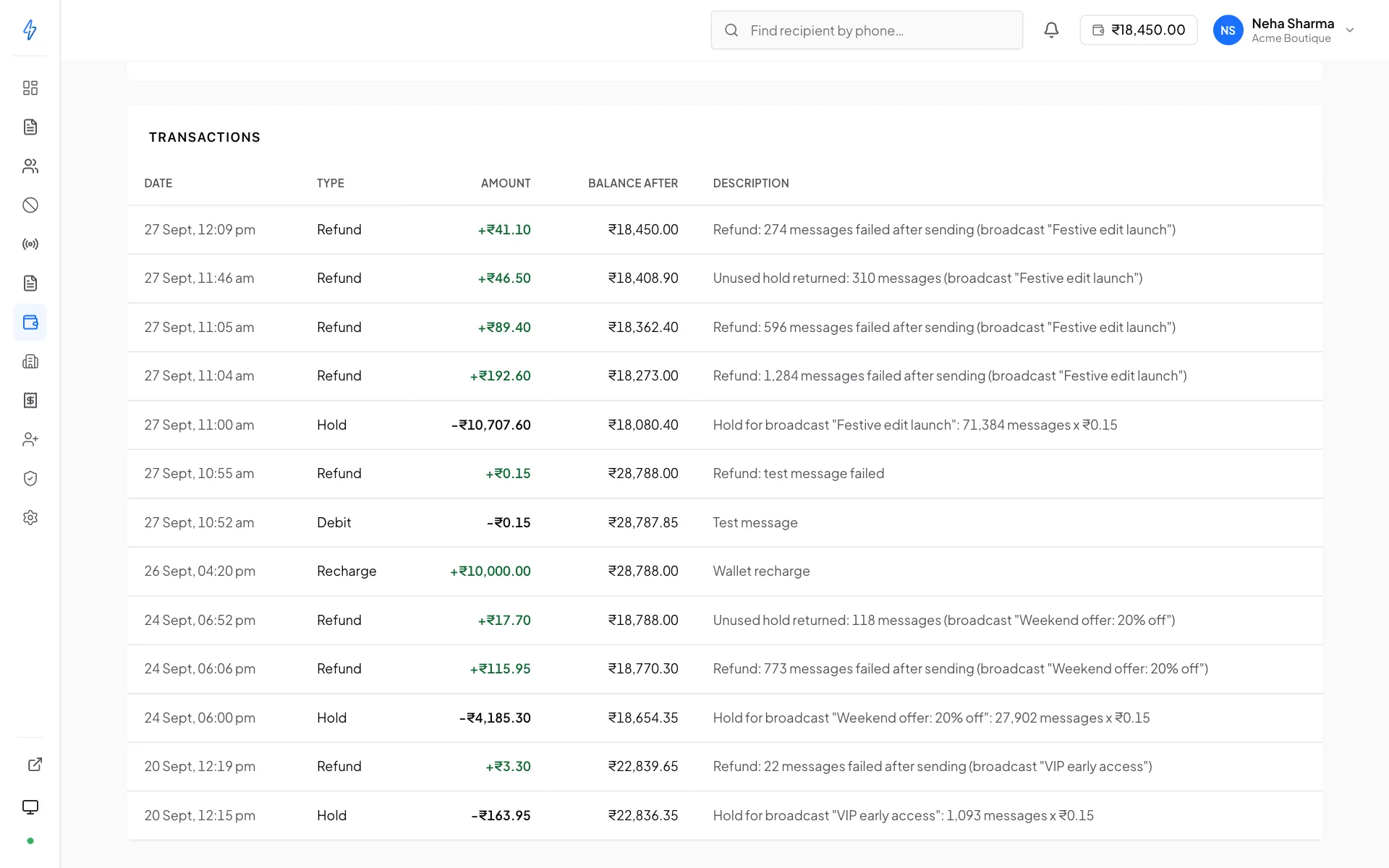
The wallet's transaction history records every movement:
A broadcast costs its hold, less the unused hold returned when it ends, less the refunds for its messages that failed after sending. If that looks wrong, open the broadcast and compare its sent and failed counts.
Reading a surprising bill
- Higher than expected
Check whether a recurring broadcast fired more often than you remembered, and whether a list grew since you last looked. Both are common and neither is obvious from the total.
- A broadcast cost more than its list size suggested
It cannot. You are charged for messages the network accepted, which is always at or below targeted, and refunded for the ones that failed after that. If the arithmetic does not work, check whether you are comparing against a different bot's price.
- Charged for messages that failed
A message that failed after the network accepted it is charged when sent and refunded when the failure is reported, usually within a few minutes. A failure report can take up to the message's validity period, about two days. If a failed message is still not refunded after that, send the broadcast id to support and it will be checked.
- A refund, then a charge for the same message
The network reported the message failed and later that it was delivered. It reached the phone, so it is charged again, once: net, you paid for it once.